


Meet the Top-Tier Superstars Inside You: The Interleukin Family (Part 2)
 source:ELK Biotechnology
 date:2026-05-28
 views:460
In the intricate network of the immune system, members of the interleukin (IL) family act as conductors. Following the classic members such as IL-1, IL-2, and IL-6, the IL-10, IL-12, and IL-17 families serve as key regulatory hubs that determine the type and outcome of immune responses. Their functions are more systematic and strategic. Like the "core grammar" of immune responses, they collectively program the complex processes of fighting pathogens, maintaining homeostasis, and repairing tissues.

How do they orchestrate these processes within the body?
I. The IL-10 Family: The "Core Regulator" of Immune Homeostasis
The IL-10 family (including IL-10, IL-19, IL-20, IL-22, IL-24, IL-26, etc.) is a key family of immunosuppressive cytokines. Acting as "mediators," they primarily transmit inhibitory signals by activating the JAK-STAT (especially STAT3) signaling pathway, effectively suppressing excessive inflammatory responses, promoting tissue repair, and preventing the immune system from damaging the body's own tissues.
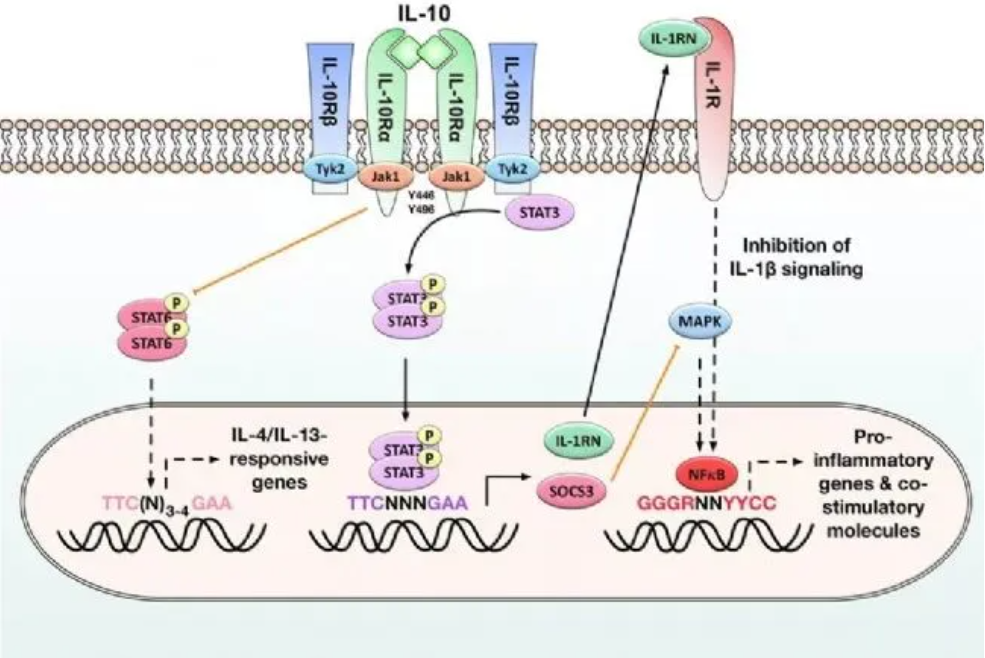
• IL-10: One of the Most Important Cytokines
IL-10 is one of the most potent anti-inflammatory cytokines in this family, mainly produced by regulatory T cells (Tregs) and macrophages. By binding to the IL-10 receptor and activating STAT3, it directly inhibits the production of pro-inflammatory cytokines such as TNF-α, IL-1β, and IL-6 by macrophages.
However, IL-10 is a "double-edged sword." In autoimmune diseases (e.g., rheumatoid arthritis, inflammatory bowel disease), its anti-inflammatory function represents a potential therapeutic direction. But in the tumor microenvironment, IL-10-mediated immunosuppression hinders anti-tumor immunity and promotes tumor escape. Current research focuses more on modulating its signaling pathway or targeted delivery.
II. The IL-12 Family: The "Heterodimeric Commanders" of Immune Responses
The uniqueness of the IL-12 family lies in the fact that its members are all heterodimers formed by different combinations of two distinct subunits (e.g., p35/p40, p19/p40). This structural diversity allows them to issue vastly different instructions. Members include IL-12, IL-23, IL-27, IL-35, and IL-39, with functions spanning both pro-inflammatory and anti-inflammatory activities.
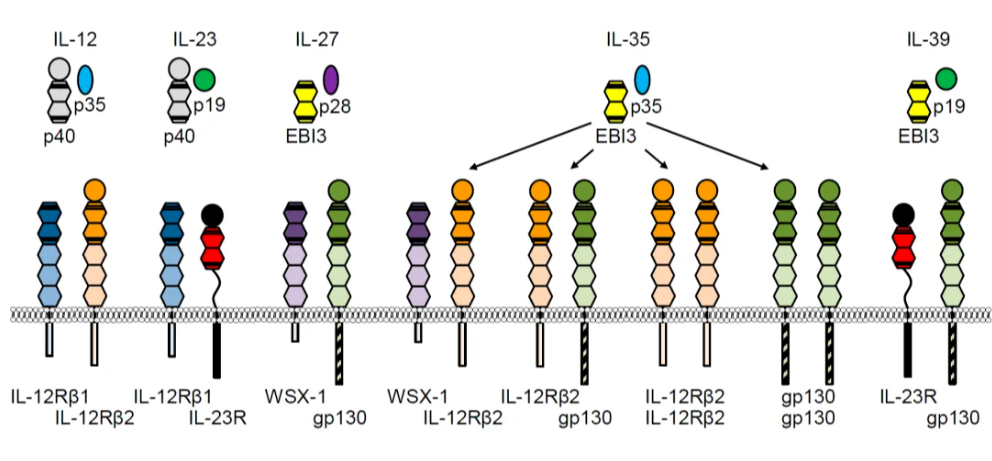
• IL-12 and IL-23: The Star Duo
IL-12 (p35/p40) is a key initiator of Th1-type immune responses, potently inducing IFN-γ production and driving immune attacks against intracellular pathogens (e.g., viruses) and tumor cells. Although systemic administration of IL-12 has been hindered in clinical trials due to toxicity, novel targeted delivery technologies (e.g., LNP) are bringing new hope for its application in cancer immunotherapy.
IL-23 acts as a stabilizer of Th17 cell responses. It does not directly initiate Th17 differentiation but is essential for maintaining Th17 cell function and promoting IL-17 production. It plays a "villain" role in autoimmune diseases such as psoriasis and psoriatic arthritis, making it a hot target for drug development.
In terms of clinical relevance, antibody drugs targeting the shared p40 subunit (ustekinumab) or the IL-23-specific p19 subunit (guselkumab, risankizumab) have been successfully used to treat psoriasis, Crohn's disease, and other conditions, validating the importance of this pathway.
III. The IL-17 Family: The "Effector Hub" Connecting Immunity and Tissue Inflammation
The IL-17 family (including IL-17A to F) consists of key effector factors that mediate defensive inflammatory responses. Among them, IL-17A has a particularly unique mechanism of action. Its main receptors (e.g., IL-17RA/RC) are widely expressed on non-immune cells such as epithelial cells, keratinocytes, and fibroblasts. Therefore, the core function of IL-17A is not to directly activate immune cells, but to act as an "alarm signal" on the tissues themselves.
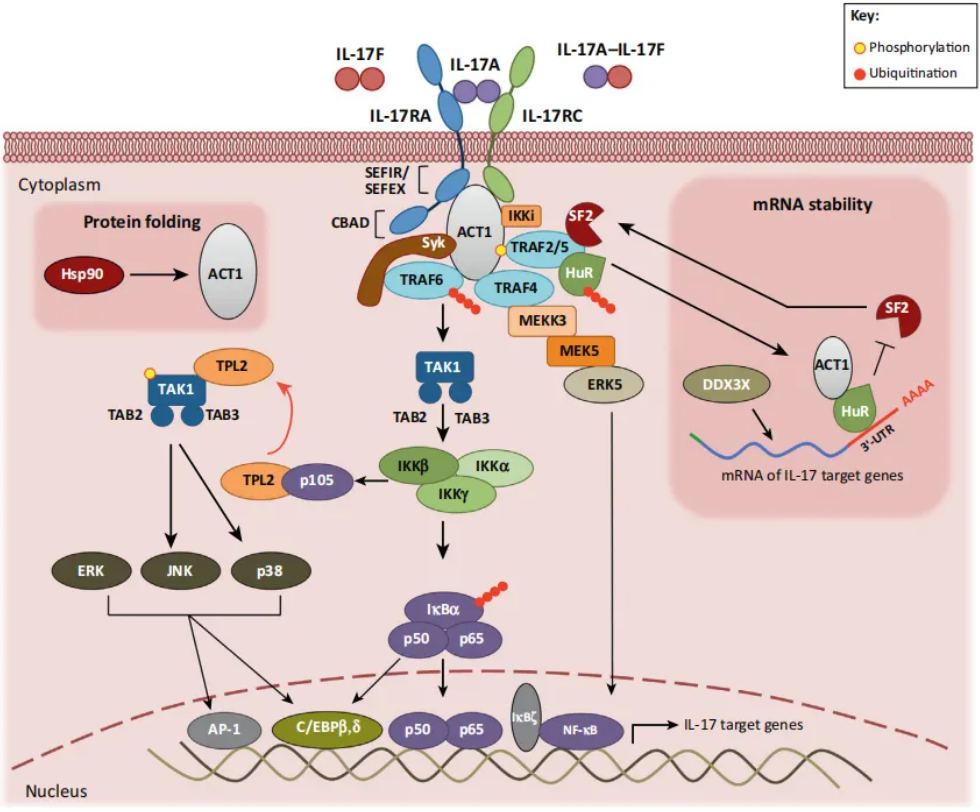
When IL-17A binds to its receptor, it activates pathways such as NF-κB and MAPK, stimulating these tissue cells to secrete large amounts of chemokines (e.g., CXCL1, CXCL8) and antimicrobial peptides. This action potently recruits and activates immune cells such as neutrophils, rapidly shifting the local tissue state from homeostasis to inflammation. Thus, IL-17A is essentially the ultimate effector molecule that bridges adaptive immune responses (e.g., Th17 cells) with specific tissue damage and inflammation, playing a central role in host defense and autoimmune diseases (e.g., psoriasis, ankylosing spondylitis).
IV. Product Recommendations
In-depth analysis of the interleukin family signaling network requires highly sensitive and specific research tools. ELK is dedicated to providing comprehensive solutions for immunology research, offering ELISA detection kits, high-purity recombinant proteins, and high-specificity antibodies covering the families mentioned above, to support researchers. Product recommendations are as follows:
ELK1147
|
Mouse IL17(Interleukin 17) ELISA Kit
|
ELK2558
|
Rat IL17(Interleukin 17) ELISA Kit
|
ELK2610
|
Human IL17(Interleukin 17) ELISA Kit
|
ELK11504
|
Simian IL23(Interleukin 23) ELISA Kit
|
ELK1050
|
Mouse IL23(Interleukin 23) ELISA Kit
|
ELK1570
|
Human IL23(Interleukin 23) ELISA Kit
|
ELK1571
|
Rat IL23(Interleukin 23) ELISA Kit
|
ELK11505
|
Simian IL27(Interleukin 27) ELISA Kit
|
ELK1572
|
Human IL27(Interleukin 27) ELISA Kit
|
ELK1573
|
Rat IL27(Interleukin 27) ELISA Kit
|
ELK9533
|
Mouse IL27(Interleukin 27) ELISA Kit
|
ELK1316
|
Mouse IL22(Interleukin 22) ELISA Kit
|
ELK2748
|
Human IL22(Interleukin 22) ELISA Kit
|
ELK8371
|
Rat IL22(Interleukin 22) ELISA Kit
|

 RETURN