
$148.00/50µL $248.00/100µL
| 50 µL | $148.00 |
| 100 µL | $248.00 |
| Product name: | TOK-1 rabbit pAb |
| Reactivity: | Human;Rat;Mouse; |
| Alternative Names: | BCCIP; TOK1; BRCA2 and CDKN1A-interacting protein; P21- and CDK-associated protein 1; Protein TOK-1 |
| Source: | Rabbit |
| Dilutions: | Western Blot: 1/500 - 1/2000. ELISA: 1/5000. Not yet tested in other applications. |
| Immunogen: | Synthesized peptide derived from TOK-1 . at AA range: 60-140 |
| Storage: | -20°C/1 year |
| Clonality: | Polyclonal |
| Isotype: | IgG |
| Concentration: | 1 mg/ml |
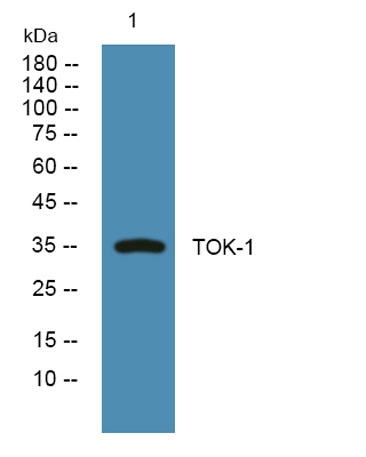
| Observed Band: | 35kD |
| GeneID: | 56647 |
| Human Swiss-Prot No: | Q9P287 |
| Cellular localization: | Nucleus . Cytoplasm, cytoskeleton, microtubule organizing center, centrosome, centriole . Cytoplasm, cytoskeleton, spindle pole . Colocalizes with BRCA2 in discrete nuclear foci (PubMed:15713648). In interphase, preferential localizes to the mother centriole (PubMed:28394342). Recruited to the spindle pole matrix and centrosome by microtubules and dynein/dynactin activity (PubMed:28394342). .; [Isoform 1]: Cytoplasm, cytoskeleton, microtubule organizing center, centrosome . Cytoplasm, cytoskeleton, spindle pole . Isoform 1/beta tends to be less abundant at, and less strongly associated with, centrosomes than isoform 2/alpha. .; [Isoform 2]: Cytoplasm, cytoskeleton, microtubule organizing center, centrosome . Cytoplasm, cytoskeleton, spindle pole . Isoform 2/alpha tends to be more abundant |
| Background: | This gene product was isolated on the basis of its interaction with BRCA2 and p21 proteins. It is an evolutionarily conserved nuclear protein with multiple interacting domains. The N-terminal half shares moderate homology with regions of calmodulin and M-calpain, suggesting that it may also bind calcium. Functional studies indicate that this protein may be an important cofactor for BRCA2 in tumor suppression, and a modulator of CDK2 kinase activity via p21. This protein has also been implicated in the regulation of BRCA2 and RAD51 nuclear focus formation, double-strand break-induced homologous recombination, and cell cycle progression. Multiple transcript variants encoding different isoforms have been described for this gene. [provided by RefSeq, Jul 2008], |