
Products

MKKS rabbit pAb
One-click to copy product information
ES14941
Size: Price:
50 µL $148.00
100 µL $248.00

Overview

Product name: MKKS rabbit pAb
Reactivity: Human; Mouse
Alternative Names: McKusick-Kaufman/Bardet-Biedl syndromes putative chaperonin (Bardet-Biedl syndrome 6 protein)
Source: Rabbit
Dilutions: WB 1:500-2000
Immunogen: Synthesized peptide derived from human MKKS AA range: 166-216
Storage: -20°C/1 year
Clonality: Polyclonal
Isotype: IgG
Concentration: 1 mg/ml
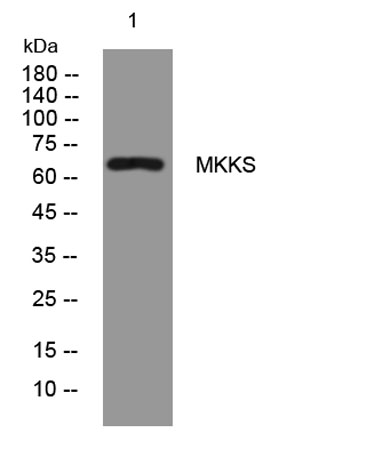
Observed Band: 65kD
GeneID: 8195
Human Swiss-Prot No: Q9NPJ1
Cellular localization: Cytoplasm, cytoskeleton, microtubule organizing center, centrosome. Cytoplasm, cytosol . Nucleus . The majority of the protein resides within the pericentriolar material (PCM), a proteinaceous tube surrounding centrioles. During interphase, the protein is confined to the lateral surfaces of the PCM but during mitosis it relocalizes throughout the PCM and is found at the intercellular bridge. The MKSS protein is highly mobile and rapidly shuttles between the cytosol and centrosome.
Background: This gene encodes a protein which shares sequence similarity with other members of the type II chaperonin family. The encoded protein is a centrosome-shuttling protein and plays an important role in cytokinesis. This protein also interacts with other type II chaperonin members to form a complex known as the BBSome, which involves ciliary membrane biogenesis. This protein is encoded by a downstream open reading frame (dORF). Several upstream open reading frames (uORFs) have been identified, which repress the translation of the dORF, and two of which can encode small mitochondrial membrane proteins. Mutations in this gene have been observed in patients with Bardet-Biedl syndrome type 6, also known as McKusick-Kaufman syndrome. Alternative splicing results in multiple transcript variants. [provided by RefSeq, Nov 2013],