
$148.00/50µL $248.00/100µL
| 50 µL | $148.00 |
| 100 µL | $248.00 |
| Product name: | NOD1 rabbit pAb |
| Reactivity: | Human; Mouse |
| Alternative Names: | Nucleotide-binding oligomerization domain-containing protein 1 (Caspase recruitment domain-containing protein 4) |
| Source: | Rabbit |
| Dilutions: | WB 1:500-2000 |
| Immunogen: | Synthesized peptide derived from human NOD1 AA range: 290-340 |
| Storage: | -20°C/1 year |
| Clonality: | Polyclonal |
| Isotype: | IgG |
| Concentration: | 1 mg/ml |
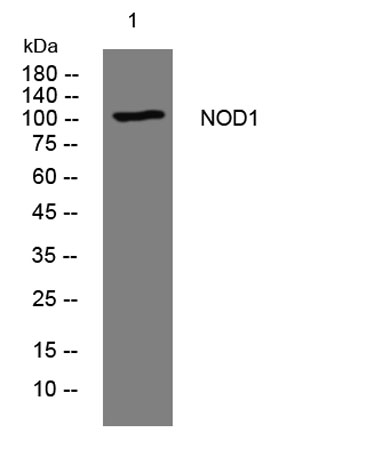
| Observed Band: | 105kD |
| GeneID: | 10392 |
| Human Swiss-Prot No: | Q9Y239 |
| Cellular localization: | Cytoplasm. Cell membrane . Apical cell membrane. Basolateral cell membrane. Detected in the cytoplasm and at the cell membrane. Following bacterial infection, localizes to bacterial entry sites in the cell membrane. Recruited to the basolateral and apical membranes in polarized epithelial cells. |
| Background: | This gene encodes a member of the NOD (nucleotide-binding oligomerization domain) family. This member is a cytosolic protein. It contains an N-terminal caspase recruitment domain (CARD), a centrally located nucleotide-binding domain (NBD), and 10 tandem leucine-rich repeats (LRRs) in its C terminus. The CARD is involved in apoptotic signaling, LRRs participate in protein-protein interactions, and mutations in the NBD may affect the process of oligomerization and subsequent function of the LRR domain. This protein is an intracellular pattern-recognition receptor (PRR) that initiates inflammation in response to a subset of bacteria through the detection of bacterial diaminopimelic acid. Multiple alternatively spliced transcript variants differring in the 5' UTR have been described, but the full-length nature of these variants has not been determined. [provided by RefSeq, Oct 2009], |